How Long Should a Resume Be? One Page, Two Pages, and the Real Rule
Ask ten people how long a resume should be and you will hear "one page, always" from at least six of them. It is advice that sounds firm and is only partly true. The real rule is simpler and more useful: a resume should be as long as it needs to be to make the reader want to talk to you, and no longer. What that means in pages depends on where you are in your career.
Why the one-page rule exists
Recruiters and hiring managers read resumes quickly, often in well under a minute on a first pass. A single page forces you to choose, and choosing is the valuable part. A one-page resume has no room for the fourth bullet about a task anyone in that role would have done, or for a job from fifteen years ago that has nothing to do with the role you want.
The rule breaks down when it is treated as a law rather than a discipline. Squeezing two pages of genuinely relevant experience onto one by shrinking the margins to half an inch and the font to nine points does not make the resume shorter to read. It makes it harder to read, which is worse than a clean second page.
A practical guide by career stage
Student or recent graduate, up to about three years of experience: one page. You do not have two pages of relevant material, and pretending you do dilutes the strong parts. Lead with your most relevant projects, internships, and coursework, and keep everything tight.
Four to ten years of experience: one to two pages. If you can show a clear progression and results on one page, stay there. If you have several roles with real, relevant achievements, a second page is fine, provided it is at least a third full. A resume that spills three lines onto page two looks like an accident.
Ten or more years, senior or specialist roles: two pages is normal. Hiring managers for senior roles expect to see scope, results, and progression. Even here, the first page must carry the strongest material, because many readers never reach the second.
Academic, research, and some government or medical roles: longer is expected. A curriculum vitae listing publications, grants, and presentations can legitimately run many pages. Follow the conventions of your field, not the general advice.
What to cut first when you are over
When a resume is too long, cut in this order:
- Old roles with no bearing on the job. Jobs from more than ten to fifteen years ago can usually be reduced to a single line with the title, employer, and years, or dropped entirely.
- Duty-style bullets. "Responsible for answering customer emails" tells the reader nothing that the job title did not already say. Keep bullets that show a result, a scale, or a decision.
- Repeated bullets across similar roles. If three roles each say you managed a team, say it fully once and keep the others to what was different.
- Skills lists padded with the obvious. Listing "Microsoft Word" for a senior analyst role signals nothing, and may even make you look junior.
- Personal details that add no value. A full home address, a photo in most English-speaking markets, and hobbies unrelated to the work can all go.
Notice that none of these cuts involve shrinking the font or margins. Keep the body text readable, ideally 10.5 to 12 points depending on the typeface, and margins around half an inch to an inch.
How to make a second page worth reading
If you do have two pages, treat them differently. Page one should be a complete argument on its own: a short summary, your most recent and most relevant roles, and your strongest results. A reader who stops there should still understand why you are a good candidate.
Page two carries the supporting evidence: earlier roles, education, certifications, and additional skills. Put your name and a page number in the header so the pages stay together if printed or separated in an inbox.
Length is not the same as density
A common mistake is judging length by page count alone. Two resumes can both fit on one page, and one will be far easier to read. Look for these signs of a resume that is too dense:
- Paragraph-style bullets running four or five lines
- No white space between sections
- More than six or seven bullets under a single role, especially older ones
- A skills block listing thirty tools
Aim for bullets of one to two lines, a clear gap between sections, and three to five bullets for each recent role. The recent roles deserve more space than the old ones; a flat structure where every job gets the same treatment hides your trajectory.
A quick test
Before you send it, hand the resume to someone who does not know your work and give them thirty seconds. Then ask what role they think you want and what you are best at. If they cannot answer, the problem is not the page count. The resume is trying to say too many things at once, and the fix is to cut toward the story that fits the job in front of you.
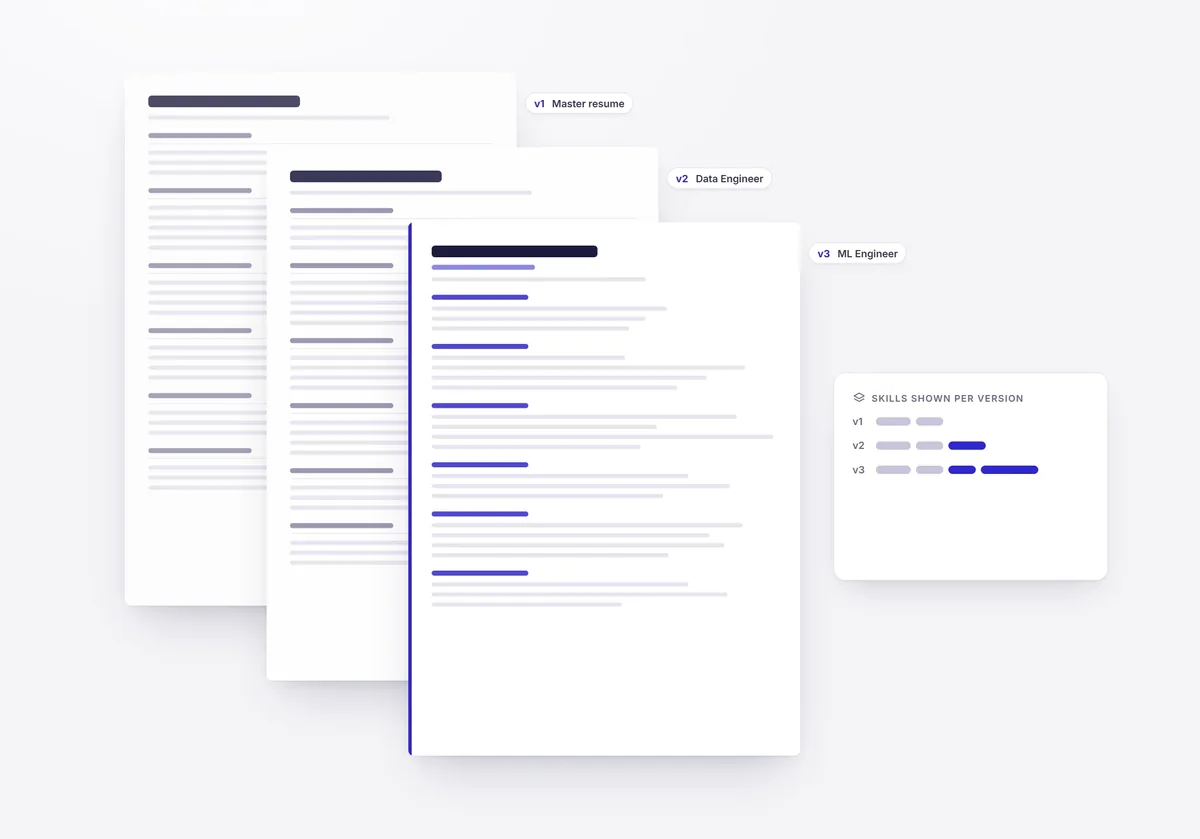
That is also why a single, long master document is worth keeping. Store every role, project, and result in one place, and then pull only what is relevant for each application. The shorter, targeted version you send is chosen from the full record rather than written from scratch each time, and nothing you have done is lost.