How to Write a Resume Summary That Earns the Next Ten Seconds
The top of your resume is the most valuable space on the page. It is also where most candidates put their weakest writing: a paragraph of adjectives that could describe anyone. "Results-driven professional with a passion for excellence" tells a hiring manager nothing, and they have read it hundreds of times.
A strong summary does one job. It tells the reader, in a few sentences, who you are professionally, what you are especially good at, and why that is relevant to this role. If the reader finishes it and thinks "this person is worth reading on," it has worked.
Do you need one at all?
Not always. A summary helps most when your career story is not obvious from your job titles alone: you are changing fields, you have a mix of experience, you are returning after a break, or you are senior and want to frame a long history. For a recent graduate with a clean, relevant history, a summary is optional, and a weak one is worse than none.
What about an objective statement? "Seeking a challenging position where I can grow" describes what you want, not what you offer. Replace it with a summary that focuses on what the employer gets.
A simple formula
Use three building blocks, in about three or four sentences:
- Who you are, with specifics. Your professional identity plus years of experience or a field. "Customer support lead with eight years in subscription software."
- What you are best at, with proof. One or two strengths, backed by a number, a scale, or a concrete outcome. "Built a support team of twelve and cut average resolution time by a third."
- What you are aiming at. A short, honest link to the role. "Looking to apply that experience to a customer success role focused on retention."
Notice what is not in there: no personality adjectives, no claims of being "passionate," and no buzzwords. Everything is something a reader could verify or question in an interview.
Before and after
Weak: "Highly motivated and detail-oriented professional with excellent communication skills and a proven track record of success. Team player who thrives in fast-paced environments."
Every phrase here is something you cannot check. "Proven track record" is the claim; the proof is missing.
Stronger: "Operations coordinator with five years in regional logistics. Reduced late deliveries by 18 percent across three warehouses by redesigning the dispatch schedule, and trained eight new coordinators. Seeking an operations analyst role where process improvement is the main focus."
This version has a role, a field, a number, a scale, and a direction. A reader can picture the person.
Career changer, before: "Experienced teacher looking for new challenges in the corporate world."
Career changer, after: "Secondary-school teacher of seven years moving into corporate training. Designed and delivered curriculum for classes of thirty, coached colleagues on lesson planning, and built a peer-observation programme adopted across the department. Completed a certificate in instructional design."
The second version translates teaching into the language of the target field. It does not hide the background; it connects it.
Words and phrases to avoid
Most of these are either empty or impossible to prove:
- Results-driven, dynamic, motivated, passionate
- Team player, self-starter, go-getter
- Proven track record, excellent communication skills
- Think outside the box, hit the ground running
If you want to convey a quality, show it. Instead of "strong leader," say what you led. Instead of "excellent communicator," mention the presentations, the client relationships, or the documentation you produced.
Match it to the job, honestly
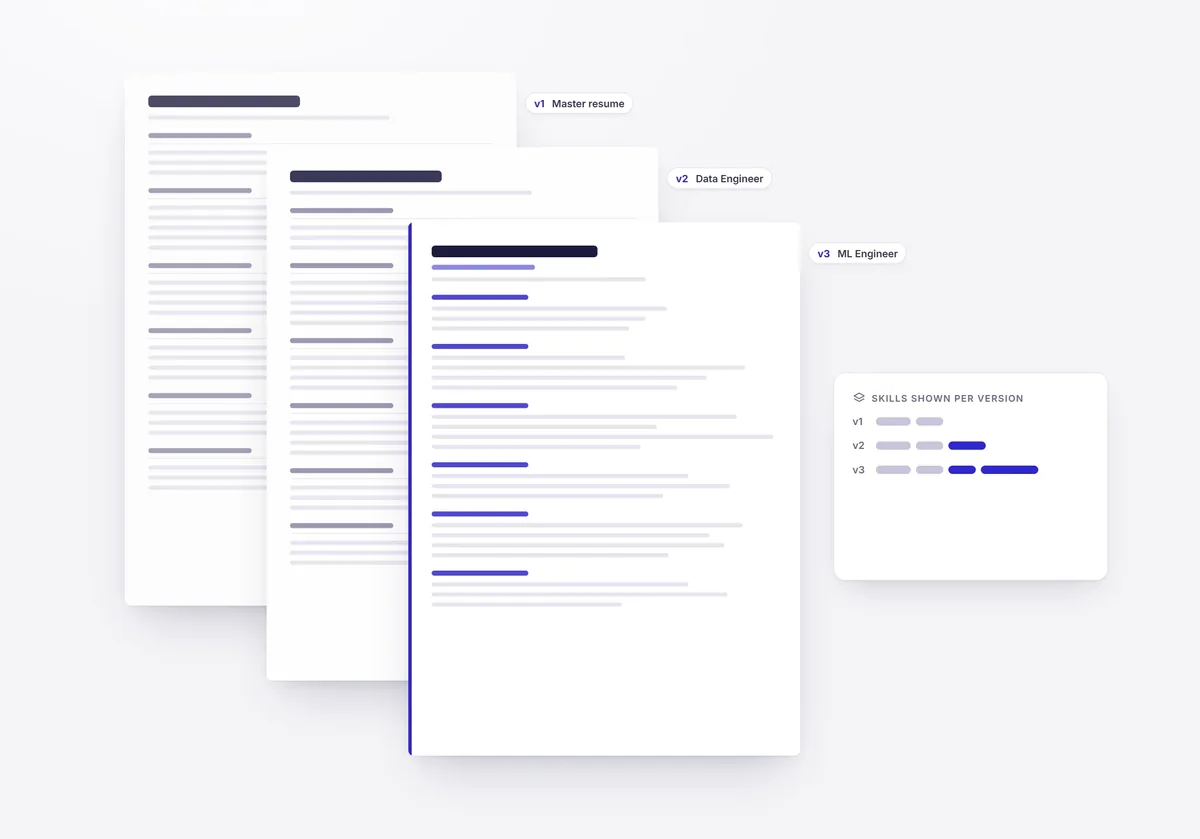
A good summary changes slightly for each application. If the posting stresses stakeholder management and your experience includes it, say so in the opening line. If the role is mainly about technical depth, lead with that instead. The facts stay the same; the emphasis moves.
The limit is honesty. Do not claim experience you do not have to echo a job description. If the role asks for something you have not done, leave it out of the summary and be ready to speak to how your related experience carries over. Our article on tailoring without lying covers where that line sits.
Length and placement
Keep it to three or four lines, or roughly 40 to 70 words. Put it directly under your name and contact details, before the experience section. Write it in plain sentences or in fragments without "I," which is the usual resume convention. "Led a team of six" reads cleaner than "I led a team of six."
Write it last
It is easier to write a summary after the rest of the resume is finished. By then you have already picked your strongest results, so the summary can simply point to them. If you write it first, you tend to reach for generic claims because you have not yet gathered the evidence.
When you have a draft, read it aloud and ask two questions. First, could this sentence appear on anyone else's resume? If so, make it more specific. Second, is each claim supported somewhere lower on the page? If a claim has no support, either add the evidence or cut the claim. A summary that makes promises the resume does not keep damages your credibility faster than having no summary at all.